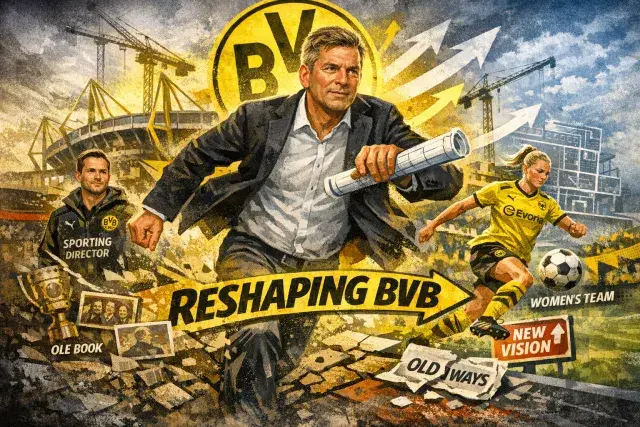
Carsten Cramer Moves to Reshape Borussia Dortmund With Urgency and Vision

Borussia Dortmund has a new voice at the top, and it is speaking in a register the club has not heard for some time: forward-looking, self-critical, and deliberately impatient. Since taking over as chief executive in late November, Carsten Cramer has moved quickly on multiple fronts — reshaping the club's sporting leadership, investing in infrastructure, and articulating a vision that breaks with the backward-looking nostalgia that defined much of the Watzke era. For a club that has spent years coasting on the memory of past glories while its identity quietly eroded, the shift in tone is as significant as any structural change.
A Calculated Break From the Familiar
Cramer's first weeks in the expanded role have been anything but ceremonial. Long-serving Director of Communications Sascha Fligge was shown the door almost immediately after Cramer assumed full oversight of communications and strategy. That was followed by one of the more surprising appointments in the club's recent history: Ole Book, a relatively inexperienced executive from second-division side SV Elversberg, was named sporting director, replacing the departing Sebastian Kehl. The decision raised eyebrows and drew scepticism. Cramer, however, framed it not as an act of desperation but as a deliberate signal — proof, in his words, that the club has "big plans" and is willing to act on them unconventionally.
The appointment of Book is a conscious departure from the closed-loop thinking that Dortmund's own supporters have criticised openly. In May of last year, the prominent fan group Südtribüne Dortmund published an open letter describing the club as "strategy-less" and accusing it of "perpetually fixing the same old mistakes with the same old methods." Cramer's response, in action if not explicitly in words, has been to accept that diagnosis and treat it as a brief.
The Architecture of Reinvention
Structural ambition at Dortmund under Cramer extends well beyond personnel changes at the top. The first-team training centre is being expanded. More significantly, the club's women's section — long Cramer's personal priority — is set to receive a purpose-built facility with its own pitches, positioned adjacent to the men's area. That adjacency is itself a statement: proximity signals parity of esteem, not just of investment.
In women's football, Cramer has already moved with conviction. The appointment of the highly decorated Ralf Kellermann as sporting director, combined with the recruitment of established forward Alexandra Popp, signals an intent to build something credible rather than cosmetic. For a club whose commercial reach now comfortably exceeds half a billion euros in annual turnover — a figure Cramer's own divisions have done much to generate — the women's project is no longer a goodwill gesture. It is a strategic bet.
Cramer describes himself as a "catalyst". The word is well chosen. A catalyst accelerates change that is already latent in the system without becoming the reaction itself. His own career bears that out: from selling table-tennis equipment in a retail outlet, to announcing at Preußen Münster and Hamburger SV, to studying law before pivoting entirely into marketing and sales, Cramer has consistently followed instinct over convention. He arrived at Dortmund in 2010 and spent over a decade building the club's commercial architecture before being elevated to the role that now gives him the authority to reshape the institution entire.
The Weight of Words, and What They Signal
Cramer has been notably direct about the turbulence surrounding the club. The abuse scandal involving a former senior official, the acrimonious and public dispute between incumbent president Dr Reinhold Lunow and challenger Hans-Joachim Watzke, and a period of underperformance on the pitch — none of these have been softened in his public remarks. He has stated plainly that the club did not emerge from the abuse affair with credit. That kind of institutional candour is not the default posture of executives in professional football, where managed ambiguity is the more common currency.
His comment that he is "not a big fan of always looking to the past, because looking back too much eventually leads to a stiff neck" may read as a general principle of leadership. In context, it functions as something more pointed — a quiet but legible critique of a culture under Watzke in which decade-old achievements were regularly invoked in place of a credible forward strategy. Whether or not Cramer intended the remark as a direct reference, its directional clarity was unmistakable.
He has also been candid about the personal dimension of his position. At the presentation of Ole Book, Cramer acknowledged that change of the kind he is pursuing requires accepting discomfort — including his own. "That starts with me," he said. It is the sort of remark that is easy to make and difficult to honour. The months ahead will determine which it is.
Credibility Requires Results, Not Just Rhetoric
The conditions for Cramer's ambitions are not unfavourable. The club is currently accumulating points at a pace it has not managed for several years, and a comfortable return to the Champions League looks probable rather than merely possible. That buys goodwill, and goodwill buys time — though not indefinitely.
His reception among supporters has been mixed. Criticism over unconventional kit designs earlier in his tenure left a residue of scepticism in sections of the fanbase. The Book appointment deepened it in some quarters. Cramer understands this. He has stated publicly that the club's ambition is not "to be number two permanently" and that this hunger must run through every department. The clarity of that aspiration is welcome. What Dortmund now needs from Cramer is not more promising language but the sustained, unglamorous work of institutional renewal — a rebuilt identity, a coherent sporting philosophy, and a culture that does not require a crisis to provoke it into action.
He has made a strong start. The pace, as he himself has implied, cannot relent.